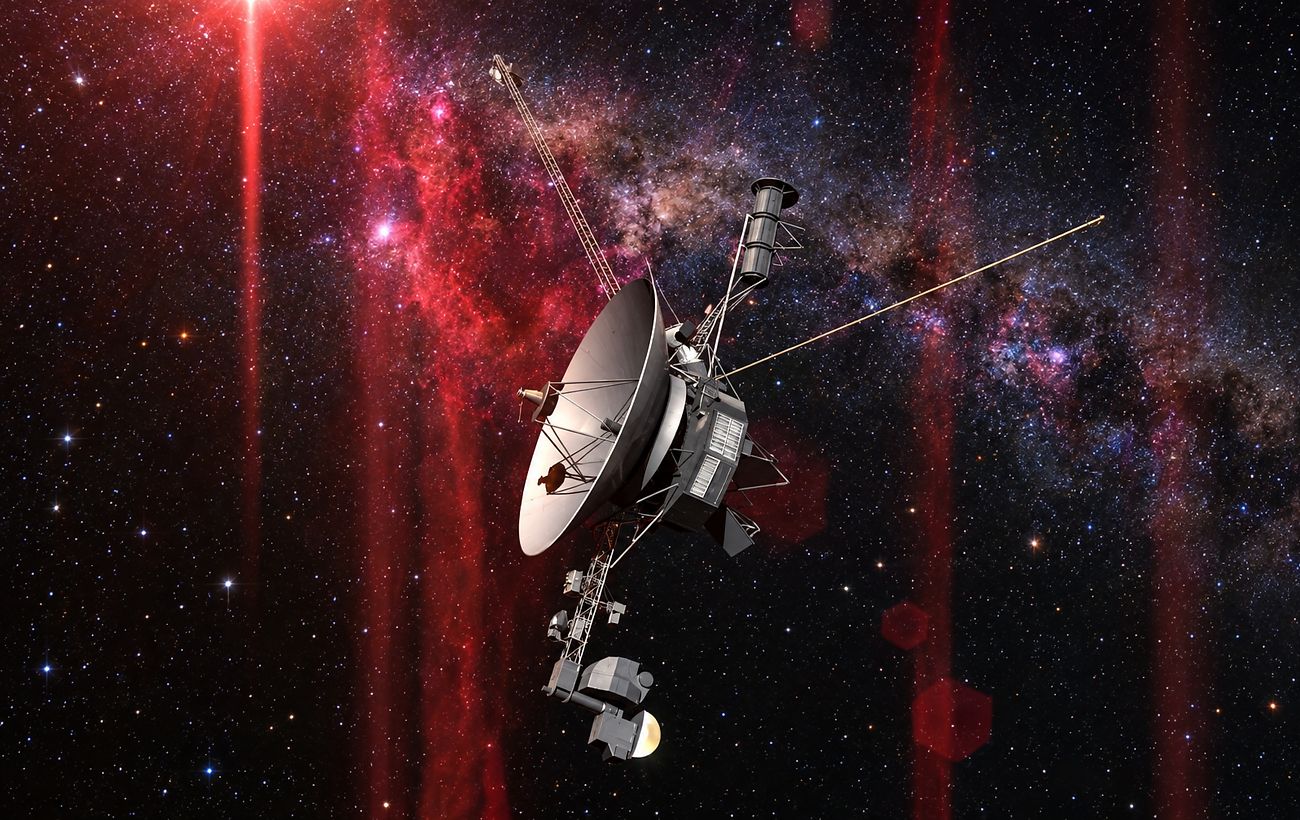
Voyager 1 reaches one light-day distance from Earth
The legendary NASA probe has reached a distance of 25 billion kilometers, resulting in a 24-hour round-trip signal time.
 💡Tech
Photo: RBC-Ukraine
Key points
- Voyager 1 is 25 billion km away
- Signal travel time is 24 hours
- Probes have been active for nearly 50 years
The Voyager 1 spacecraft has officially reached a historic milestone, traveling so far that it now takes light exactly 24 hours to cover the distance from Earth. As of November 18, 2026, the probe is over 25 billion kilometers away, marking a significant achievement in deep space exploration.
Different paths for the twin probes
Although both Voyager probes were launched in 1977 just weeks apart, their trajectories diverged significantly. Voyager 1 was placed on a faster path to study Jupiter and Saturn. Conversely, Voyager 2 followed a more complex route, utilizing gravity assists from Uranus and Neptune, which ultimately resulted in a lower cruising speed compared to its counterpart.
Both probes are currently operating in interstellar space. NASA's Jet Propulsion Laboratory continues to manage these aging explorers, carefully redistributing power to keep critical instruments online as their nuclear power sources slowly deplete.
Source RBC-Ukraine — rbc.ua/ukr/news/voyager-1-vidletiv-svitloviy-den-vid-zemli-17950032… ↗
Read next
 ⚽Sport
Ukraine prepares for Euro 2028 qualifiers: draw details and Russia's exclusion
UEFA has announced the seeding pots for the Euro 2028 qualifiers. Ukraine has been placed in the third pot, while the Russian national team remains excluded from the tour…
 🚌Transport
Shipping Security and Support for Farmers: Presidential Briefing
President Volodymyr Zelenskyy held a meeting on protecting Black Sea ports and ensuring the stability of grain export routes.
 💼Economy
Business environment under pressure: developers report rise in groundless investigative actions
The Ukrainian Developers Association states that approximately half of all investigative actions target companies that are not subjects of criminal proceedings.
 🏛️Politics
SBU General Serhiy Duka admits to destroying his smartphones with an axe
SBU Major General Serhiy Duka admitted during a parliamentary commission hearing that he destroyed his phones during search operations.
 👥Society
SBU General Duka Case: 'Carthage' Suspect Comments on 65 Million Bail Collection
SBU General Serhii Duka confirmed colleagues raised money for his bail, denying any coercion was involved.
 🏛️Politics
Carthage Case: HACC arrests suspect known as 'Criminal'
The High Anti-Corruption Court has remanded Andrey Osipov into custody, whom investigators identify as the leader of a major criminal organization.